Instagram Business
Lead ad question on Story
Show lead ad form's first question directly on Story ad
Owned design strategy and execution for the lead gen first question on Story — a 3-week design timeline, collaborating with 1 PM, 4 Eng, 1 UXR, 1 DS, and 1 CD.
- Product Designer
- Design Strategy
Context
The question shows up a beat too late
Instagram lead ads ask people a question to start a form. Today, that question only appears once someone taps into the ad's end card — this is the story of moving it to the moment people are actually paying attention, which drove more form submission for businesses and contributed incremental revenue to Meta.
Why it matters
- Consumer: A form asking for personal information is a lot to ask from someone who just tapped an ad out of curiosity. There's no warm-up, no sense of whether it's worth their time — so most people don't start.
- Advertiser: Lead gen ads only pay off when someone submits the form. Low completion rates mean high cost per lead, and the budget stops making sense.
- Meta: If consumers don't fill out the form and advertisers don't get the result they were hoping for, Meta loses lead gen revenue.
Hypothesis
How might we integrate actionable elements within the ad itself?
...to enhance user understanding and encourage engagement, leading to higher form submission for the business. Before: a siloed lead gen ad experience, where the ad's context and the first question lived separately. After: a uniform experience, where they live together.
Solution
Three ways to bring the question onto the Story itself
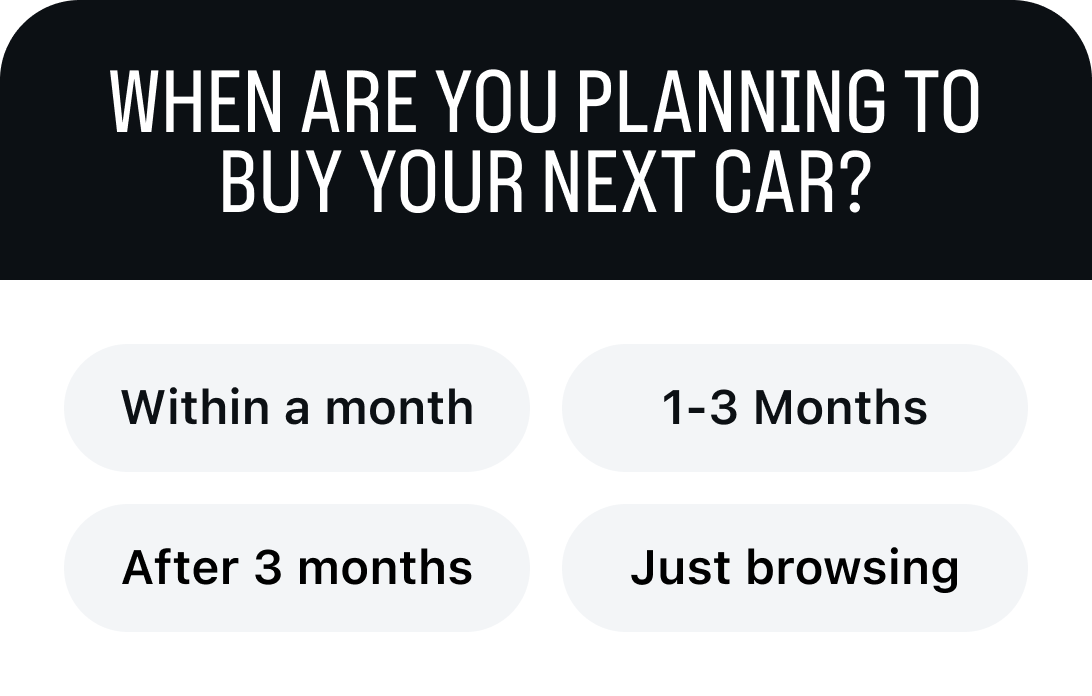
I explored three directions, evaluated against four design principles — nativity, scalability, simplicity, and contextuality: a sticker overlay, a mid-scene placement within the ad's content, and pill-shaped chips over the media. The sticker direction scored highest across all four and became the aligned direction. From there, I tested how and when it should reveal: full reveal on impression versus revealing only after a pre-dwell state (mirroring the ad CTA's existing dwell pattern). Full reveal aligned better with the goal of surfacing context immediately.
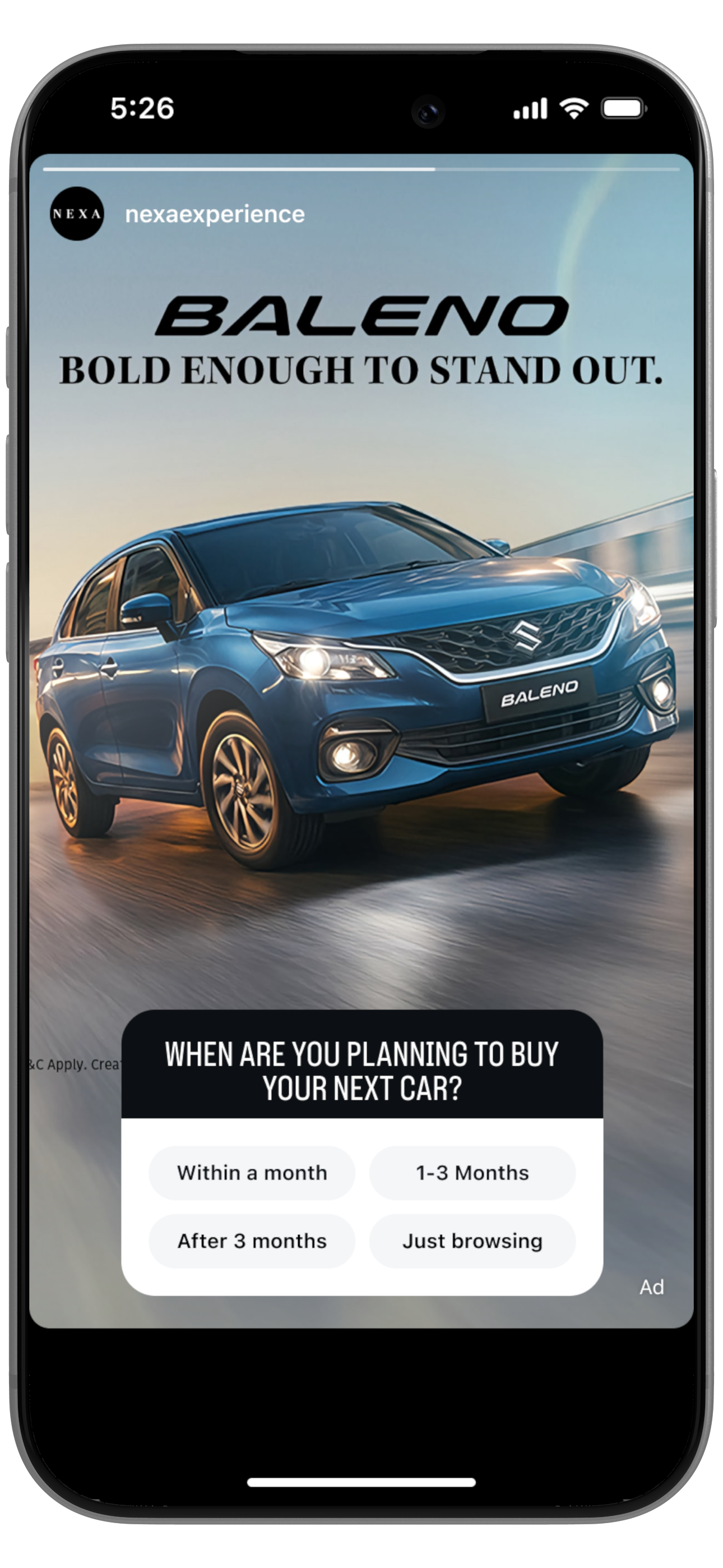
Sticker
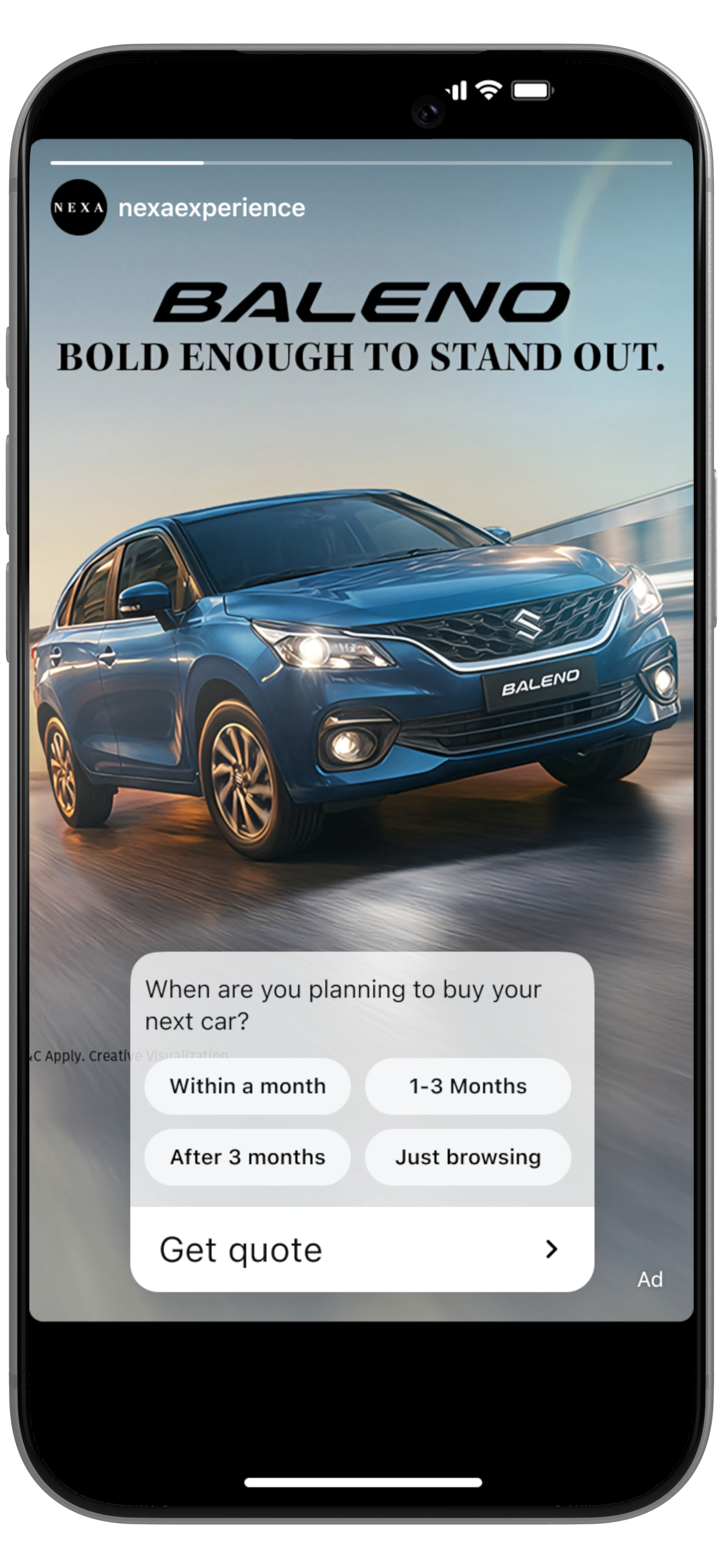
Mid-scene
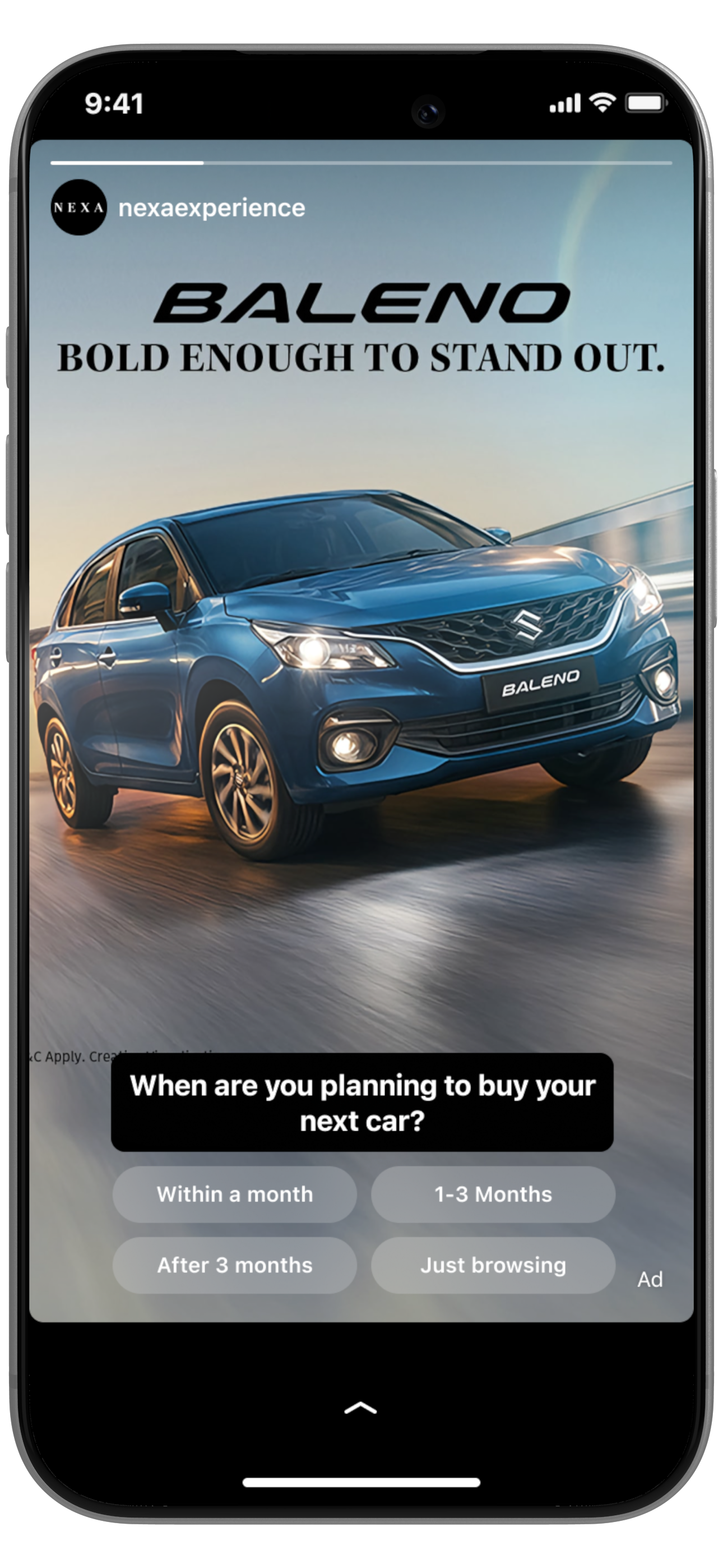
Pills
Experiment 1
Solid vs. transparent background
Tested a solid vs. transparent background for the sticker.
Solid background
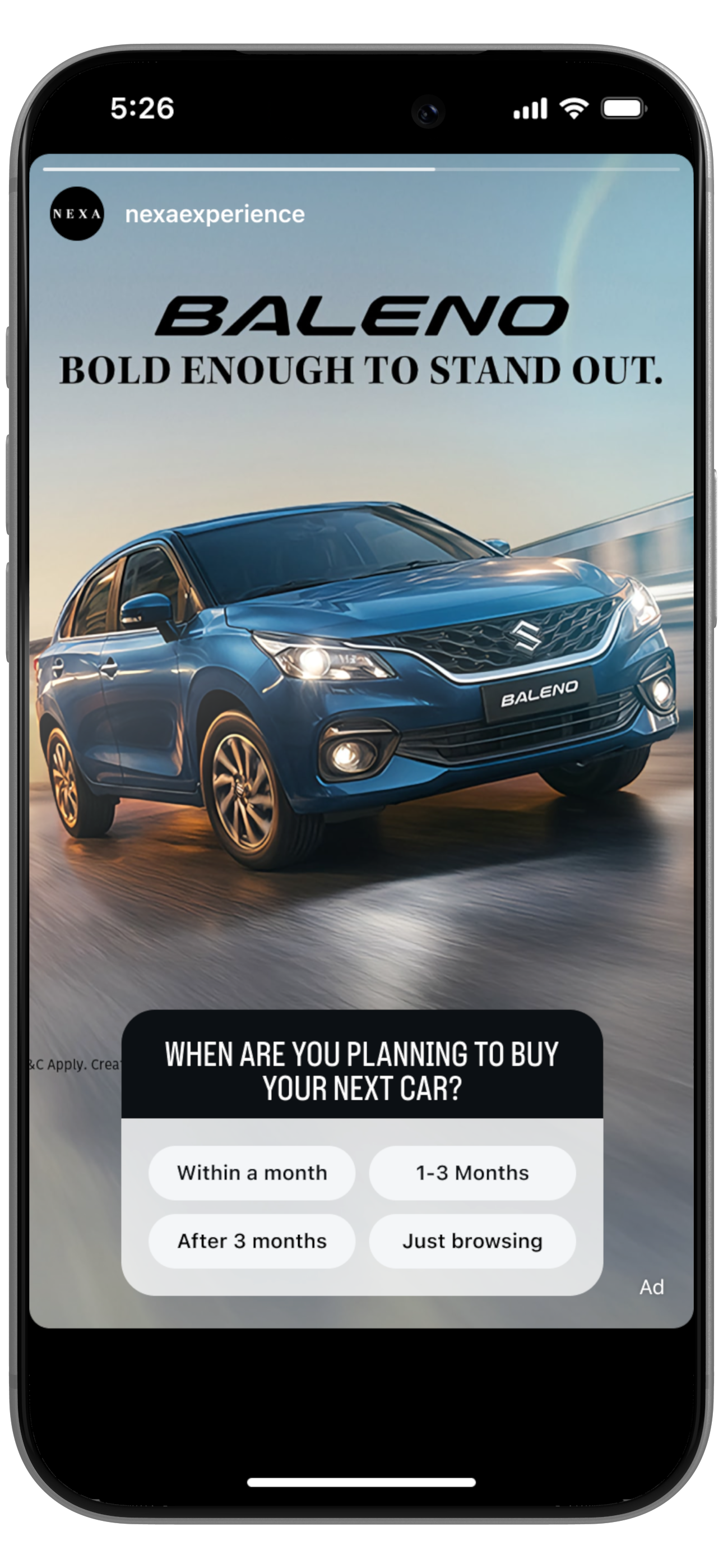
Transparent background
Experiment 2
Sticker dwell time
Tested how long the sticker should dwell before revealing the question — 0s, 2s, and 4s. Showing it immediately (0s) won, validating the hypothesis that earlier opportunity to engage leads to more completed forms.
0s dwell
2s dwell
4s dwell
Launch
Considered consumer sentiment before rollout — this experience reaches less than 1% of Instagram Story ads, and ~20% of Instagram lead gen ads.
Next steps
Creating a system
Based on the launch of this pattern for multiple-choice questions, the next step is extending it to other question types — short answer and contact info — to bring consistency across the lead gen ad system.
Key takeaways
The lever was where we asked, not how it looked. Relocating the question to the first card — the moment of attention — was the step-change. The biggest win came from a placement decision, not a visual one.
Full case study is under NDA
I'd love to walk you through the details. Contact me to learn more about this project.